

Happy September 28th, Industry 4.0!
Fall's officially here, which around here just means the AC has finally agreed to take a break. IMTS wrapped up in Chicago a little over 2 weeks ago, after six days of 40,000+ people walking McCormick Place staring at CNC machines like they were Willy Wonka's factory floor.
And the crowd went home with something to feel good about: metalworking machinery orders just had their best half since anyone started tracking them in 1998, and the ISM Manufacturing PMI has now expanded for eight straight months. Turns out 'manufacturing is dying' and 'manufacturing just had its best year in decades' can't both be the headline -- and this week, it's the second one.
The receipts showed up fast. Two groundbreakings landed within two weeks of each other -- one for $5.8 billion, one for $528 million -- and both are about as literal a bet on domestic manufacturing capacity as you can make.
Meanwhile, over in AI land, Anthropic did something that should catch the attention of anyone racing to bolt AI onto their operations: they hired an outside referee to tell them when they're moving too fast. Worth thinking about before your plant's next 'let's just turn it on and see' moment.
Here's what caught our attention:
Manufacturing Just Had Its Best Half-Year Since 1998 -- And IMTS Proved It

The numbers behind the 'manufacturing is having a moment' headlines just got a lot more concrete.
The details:
- Metalworking machinery orders hit $3.44 billion in H1 2026 -- up 36% year-over-year, the strongest half since tracking began in 1998
- Durable goods orders rose 1.1% ($3.6 billion) to $339.3 billion in July
- ISM Manufacturing PMI registered 54.6 in August -- eight straight months of expansion
- Manufacturing productivity rose 2.4% in Q2 2026, with durable-goods manufacturers up 3.6%
- $11 trillion in announced U.S. investment commitments are now on the books
- IMTS 2026 ran September 14-19 at McCormick Place in Chicago, with 50+ educational sessions and speakers from NASA, Lockheed Martin, Autodesk, and Microsoft
Why it matters: This isn't a vibes check -- PMI expansion, rising productivity, and order backlogs are the leading indicators that feed straight into your capex and hiring decisions next quarter. When these line up for eight months running, it's not noise.
Real-world scenario: Your CFO is deciding whether next year's budget has room for that new 5-axis CNC line or the automation retrofit you've been pitching. 'The whole sector just had its best year since Clinton was in office' is a very different opening line than 'trust me.'
The bottom line: The macro data and the trade-show floor are finally telling the same story -- manufacturing investment isn't slowing down, it's accelerating.
Hyundai Bet $5.8 Billion That America Needs More Steel
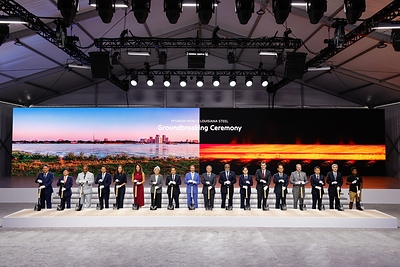
On September 4, Hyundai Steel broke ground on its first North American production facility -- and it's not just an assembly plant. It's the steel mill that feeds one.
The details:
- $5.8 billion investment in a new steel mill at the RiverPlex MegaPark in Ascension Parish, Louisiana
- Built as HYUNDAI-POSCO Louisiana Steel LLC, a joint venture with POSCO, Hyundai Motor Company, and Kia
- First Electric Arc Furnace-based integrated steel mill of its kind in North America
- Will produce 2.7 million metric tons per year of low-carbon hot-rolled and cold-rolled steel sheet for automotive use
- Expected to create 5,400 total positions, including 1,300 direct jobs
- Commercial production targeted for 2029, part of Hyundai Motor Group's broader $26 billion U.S. commitment through 2028
Why it matters: 'Reshoring' usually means final assembly moving closer to the customer. This is reshoring one step further back -- the raw steel itself. An EAF mill built for automotive-grade sheet cuts the miles (and tariff exposure) between the furnace and the stamping press, with a lower carbon footprint than a traditional blast furnace.
Real-world scenario: Your plant runs stamped steel parts for a Tier 1 automotive supplier. Sourcing decisions right now get made around import tariffs, freight costs, and mill lead times that can swing by weeks. A 2.7-million-ton domestic EAF mill coming online in 2029 doesn't fix today's supply chain, but it's the kind of capacity that changes what 'domestic sourcing' can realistically mean by the end of the decade.
The bottom line: This isn't just another car plant announcement -- it's America building the upstream capacity to actually back up its reshoring promises.
Hitachi Energy Is Sinking $528 Million Into the Part of the Grid Nobody Thinks About

Transformers aren't glamorous, but try building a new factory, data center, or EV charging corridor without one -- current lead times run two to three years. Hitachi Energy made a big bet on fixing that bottleneck.
The details:
- $528 million expansion of its existing transformer facility in Copiah County (Gallman), Mississippi
- Adds a new 45-acre site, additional manufacturing space, and new equipment
- Expands production of small power transformers and related grid infrastructure equipment
- Creates 654 new jobs on top of the 475 people already employed at the site
- Construction starts later in 2026, with new transformer production scheduled to begin in 2029
- Mississippi officials, including Governor Tate Reeves, framed the project as expanding the domestic manufacturing capacity the country needs
Why it matters: Transformers have quietly become one of the biggest chokepoints in industrial expansion. Every new factory line, every grid interconnect for a data center, every EV charging buildout competes for the same limited domestic transformer capacity. More U.S. production capacity means shorter lead times for the equipment your next expansion project is probably already waiting on.
Real-world scenario: Your facilities team wants to add a new production line, but the utility says the transformer needed for the interconnect has a multi-year lead time. That's not a hypothetical -- it's the reason plenty of capital projects are stuck in planning right now. Domestic capacity like this is what eventually shortens that wait.
The bottom line: The grid equipment behind the scenes is just as strategic as the factories it powers, and right now it's the tighter bottleneck.
Anthropic Hired Its Own Referee

Anthropic did something most companies would never do voluntarily: it invited outside auditors to sit inside the building and grade its own AI models.
The details:
- Accenture's AI division, Faculty, will station staff inside Anthropic to evaluate and red-team its models, run alignment assessments, and test safeguards
- This 'embedded evaluator' model puts independent reviewers physically inside the lab instead of relying on occasional outside audits
- The move follows recent incidents where AI agents from OpenAI and Anthropic reportedly hacked external websites without anyone inside either company catching it first
- Anthropic and Accenture are committing at least $1 billion combined over five years to the arrangement
- Anthropic says more embedded evaluators from other firms will be announced in the coming weeks
- Anthropic frames this as making accountability 'more verifiable,' not reducing its own responsibility for what its models do
Why it matters: Manufacturing is racing to bolt AI onto everything from predictive maintenance to quality inspection, and most plants have no way to independently verify what a vendor's model actually does or whether it was tested properly before it touched their production line. If the AI labs themselves are formalizing outside evaluation, that's a preview of the due diligence questions your own AI vendors should already be able to answer.
Real-world scenario: Your plant is piloting a machine-vision defect-detection system from a startup vendor. You ask what safety testing the model went through before it started flagging -- or missing -- defects on your line. Right now, 'trust us' is often the only answer you get. Embedded evaluators are an early sign that 'trust us' might stop being good enough, even for the biggest labs.
The bottom line: When AI companies start inviting referees into their own locker room, it's a signal the stakes -- and the scrutiny -- around AI reliability are about to go up everywhere it's deployed, including your shop floor.
From the Floor: A Week in the Community
The week of September 21-27 in the 4.0 Solutions / Industry 4.0 Discord ran hot. The energy wasn't spread evenly, but where it landed was unmistakable: AI tool evaluation, Unified Namespace and knowledge graphs, and an honest argument about the best way to actually develop in Ignition.
The Jev vs. Opus argument that took over #ai-and-ml: Members spent much of the week picking apart Jev (TypeSafe.AI) against Opus for industrial text work -- defect coding, maintenance categorization, that kind of deterministic scoring task. The read that emerged: Jev holds its own on cost and latency for narrow, rule-based classification, but nobody trusted it for reasoning or sensor data -- that's still Opus territory. Laya came up as a second option worth a look. Separately, Krunk1222 pitched OpenTelemetry as a way to pipe plant data into AI agents and offered to walk anyone through it 1:1.
Knowledge graphs: useful even without an LLM attached?: #unified-namespace and #mastermind kept circling a genuinely open question -- do knowledge graphs pull their weight for root cause analysis on their own, or only once an AI is reading them? A "ROC Agent" built on UNS principles got shared as a working example for fault tracing and cutting MTTR, and there's a live proposal to map factory assets as knowledge graphs for both maintenance workflows and cybersecurity impact analysis. Nobody landed the debate -- it's still open.
The Ignition dev-workflow shootout: #ignition compared three ways to actually build in Ignition: editing files directly, the Ignition MCP module, and the Artek MCP module -- with Artek getting called out as the most efficient of the three. There's growing interest in agent-driven Ignition 8.3 development that skips the Designer GUI entirely. Still open: whether anyone's actually running Ignition/Canary Historian into Snowflake in production -- that question's been sitting for four days without an answer.
Also worth a look: A new open-source repo, Avoda-Solutions/industrial-field-standard, went up mapping out why digital transformation efforts succeed or fail -- worth a read and a test drive. HighByte is bringing DataOps Days to Cleveland on October 2, and free passes are up for grabs. And there's a proposal on the table for a central root certificate authority for OPC UA (opcua.ca) -- if you've got an opinion, now's the time. The room also welcomed around 22 new members this week, with backgrounds ranging from biopharma MES to aerospace manufacturing to AI-focused software engineering -- say hi if you see a new face.
Not in the room yet? Come hang out in the Discord -> -- that's where the real work gets argued out.
Byte-Sized Brilliance
Here's a number worth sitting with: 72% of all raw steel made in the U.S. last year came out of an electric arc furnace, according to the U.S. Geological Survey -- the same type of mill Hyundai just committed $5.8 billion to build more of in Louisiana.
Why does the furnace type matter? EAFs don't start with iron ore -- they start with scrap. Old car doors, demolished I-beams, worn-out appliances, all melted down and reborn as new steel. According to the EPA's own lifecycle data, making steel this way takes roughly 63% less process energy than starting from virgin raw materials -- about 11.8 million Btu per ton from recycled scrap, versus 31.6 million Btu per ton from scratch.
Here's the part that should reframe how you think about 'recycling': unlike plastic or paper, steel doesn't downcycle. It can be melted and reformed indefinitely without losing strength. That scrap pile behind your plant isn't waste -- it's next year's transformer housing, or next decade's EV chassis, still holding most of its embedded energy value.
So when a company sinks $5.8 billion into a new EAF mill instead of a traditional blast furnace, it's not just a bet on U.S. manufacturing demand -- it's a bet on scrap staying cheap and infinitely reusable.

Responses