
Presented by

Labor Day weekend is one text message away, which means half of America is already mentally out of office and the other half is quietly panicking about whatever's due before the long weekend. Either way, nobody wants to be the one explaining a line-down call from a beach chair.
Good news: this week's stories are basically a love letter to letting machines carry more of the load — literally, in one case. A construction equipment giant is turning a decade of jobsite sensor data into AI recommendations customers actually use. A furniture manufacturer let an AI agent loose on its changeover process and cut the time by 93%. And a major shipbuilder just signed a nine-figure bet on robots that weld, grind, and paint submarines so humans don't have to.
We've also got news of our own: 4.0 Solutions just launched a YouTube channel where you can watch Walker build — and troubleshoot, and occasionally curse at — real Industry 4.0 systems live, no highlight reel required.
Here's what caught our attention:
Caterpillar Is Turning 16 Petabytes of Machine Data Into an AI Playbook

Caterpillar has spent decades automating mining sites. Now it's applying that same playbook — minus the giant autonomous haul trucks — to AI across its entire business.
The details:
- Cat has roughly 1.6 million connected assets worldwide feeding more than 16 petabytes of structured data back to the company.
- That data is powering a new voice-command Cat AI Assistant that lets field technicians pull up repair procedures, troubleshoot issues, and identify parts hands-free.
- Behind the scenes, Cat is also using AI agents to modernize legacy code and hunt for software defects, plus digital twins and site-scanning software for manufacturing analysis.
- CTO Jaime Mineart's big lesson from mining automation: the technology was never the hard part. The hard part is fitting it into a customer's actual jobsite workflows and getting experienced operators to trust — and train — the system.
- Cat is backing that lesson with a $100 million workforce training investment over the next five years, across 118,000 employees.
Why it matters for manufacturing: Cat's data hoard didn't turn into anything useful on its own — someone had to decide what recommendations actually help a technician standing next to a broken machine, versus what just looks impressive in a slide deck. That's the same fork in the road every plant hits with historian data: collecting it is the easy 20%. Turning it into something a maintenance tech actually acts on is the other 80%.
Real-world scenario: Imagine your maintenance supervisor asking a headset "why did the stamping press trip twice this shift" and getting a straight answer pulled from years of sensor history — instead of digging through three different SCADA screens and a paper logbook from the night shift. That's the promise here. Whether it works depends entirely on the workflow integration Cat is now saying is the hard part.
The bottom line: Sixteen petabytes of data is worthless if it doesn't reach the person standing on the floor at the moment they need it. Cat's betting $100 million that getting people to trust and use the tool matters more than the tool itself — and that's a bet most plants underfund.
This Furniture Maker Cut Changeover Time From 19 Minutes to 84 Seconds

Sauder Woodworking — one of North America's largest IKEA suppliers — let an agentic AI loose on its changeover process. The results should make anyone running a job-shop floor sit up.
The details:
- Sauder rolled out all four modules of Redzone's Connected Workforce platform within a year, starting with a pilot at its IKEA production facility.
- The newest piece, ChampionAI, is an agentic layer that watches frontline activity and operational patterns, then flags issues in real time instead of waiting for a daily report — and lets supervisors just ask it questions about what's happening on the floor right now.
- Average changeover time dropped 93%, from 19 minutes down to 84 seconds.
- Overall Equipment Effectiveness (OEE) — a standard measure of how much of a machine's available production time actually gets used well — climbed from 50% to above 70%.
- Productivity rose 40% in the first year, with frontline workers submitting three times as many improvement ideas.
- An independent ROI study pegged the payback at seven months, with roughly $3 million saved in inventory carrying costs and $400,000 in annual maintenance savings.
Why it matters for manufacturing: Changeover time is one of those metrics everyone tracks and almost nobody fixes, because the fix usually means untangling tribal knowledge that lives in one operator's head. An AI layer that can watch the pattern across every shift — not just the shift with the best operator — is a genuinely different kind of tool than another dashboard.
Real-world scenario: Line 2 needs to swap from cutting one panel size to another. Normally that's 19 minutes of hunting for the right jig, re-checking settings, and waiting on whoever remembers the trick from last time. Now it's under a minute and a half, because the system already knows the sequence and flags the one step people usually forget.
The bottom line: When America's largest military shipbuilder is willing to put up to $900 million in future production work behind robotics that must prove themselves before they get paid, it's a strong vote of confidence that adaptive automation for skilled trades — welding especially — is moving into high-stakes production.
HII Just Bet Up to $900M on Robots That Weld, Grind, and Paint Submarines
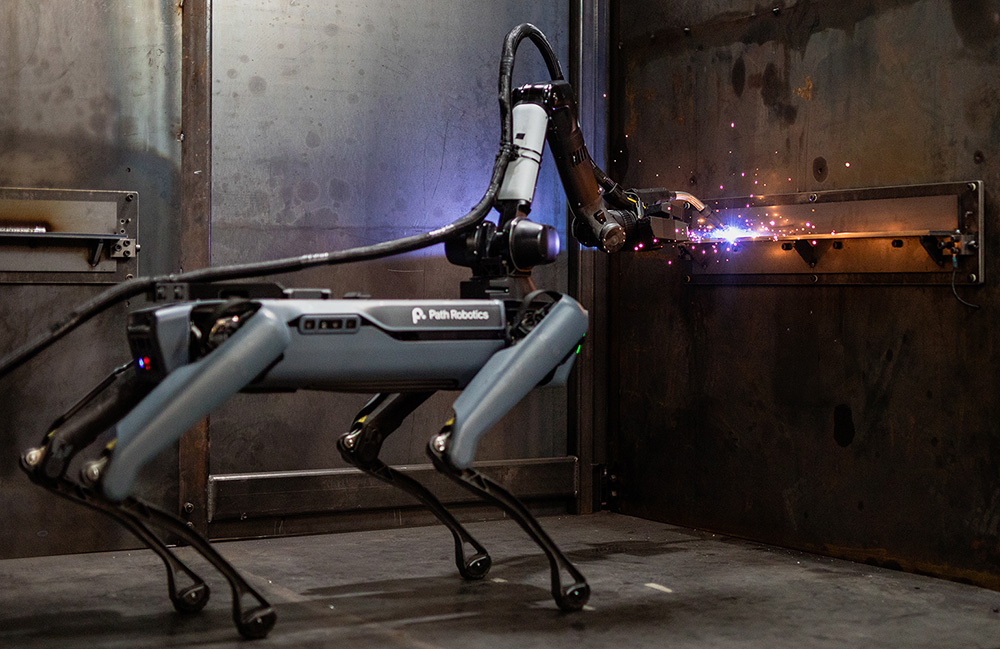
HII (Huntington Ingalls Industries) signed performance-based production agreements with Path Robotics and GrayMatter Robotics worth up to $900 million over seven years — one of the largest robotics commitments in shipbuilding history.
The details:
- The deal is performance-based: HII only pays out as the robots hit cost, schedule, and quality milestones, starting with small steel structures before expanding to full units and modules.
- Path Robotics is bringing adaptive AI welding technology; GrayMatter Robotics is contributing autonomous systems for surface prep and inspection.
- Scope covers autonomous welding, grinding, blasting, painting, assembly, and inspection across aircraft carriers, submarines, destroyers, amphibious ships, future frigates, and unmanned surface vessels.
- HII plans to outsource more than 2.5 million shipbuilding hours in 2026 alone — a 30% jump from 2025 — and this agreement is part of building the distributed manufacturing capacity to support that.
- The stated goal is addressing a real labor shortage in skilled shipbuilding trades, not just cutting headcount.
Why it matters for manufacturing: Performance-based robotics contracts are a signal worth watching regardless of your industry. Instead of buying a robot cell and hoping it hits spec, HII is only paying as the vendor proves out real-world results — a structure that shifts risk onto the automation provider and could become the template for how plants buy robotics going forward.
Real-world scenario: Picture a shipyard weld cell where the joint geometry changes slightly from hull to hull. A rigid, pre-programmed robot chokes on that variation. Adaptive welding AI is built to handle exactly that kind of variability — which is the same problem most job-shop welding cells have struggled to automate for decades.
The bottom line: When a company sinks $900 million into robots that only get paid when they perform, it's a strong vote of confidence that adaptive automation for skilled trades — welding especially — has finally cleared the bar for high-stakes production work.
Presented by Neuron Industries
Quick intro if you haven’t crossed paths yet: Neuron Industries is a small team out of El Segundo, CA building Cortex AIC — an AI-native industrial controller that brings the PLC, HMI, historian, and IDE into a single system instead of four separate tools talking to each other on a good day.
They just published a case study worth five minutes of your time: how CureWood replaced a 1991 Siemens S5 in a single 8-hour cutover — 189 hardwired I/O points, roughly three hours of human engineering time, and $9,950 all-in. The machine ran correctly on the first power-up.
That’s the part worth paying attention to. The team translated and simulated the legacy control program before touching the machine, proved the logic in advance, then completed the physical migration in one shift instead of burning a weekend troubleshooting on the plant floor.
Read the CureWood case study →
If you’re sitting on a control system of similar vintage and want to see whether Cortex AIC fits your floor, the Neuron team is offering readers a quick, no-pressure look: grab 20 minutes with the Neuron team →
We Started a New YouTube Channel — and We're Not Cutting Out the Mistakes

This one's about us. 4.0 Solutions just launched 4.0 Solutions Lab on YouTube, and it's not another polished tutorial channel — it's Walker Reynolds building and testing real Industry 4.0 systems live, unedited.
The details:
- The channel (@40SolutionsLab) kicked off this past weekend with a two-part livestream: "Flow Atlas First Look," where Walker installed and stress-tested Flow Software's Atlas platform in real time.
- The tagline says it best: "Raw builds, partner product tests, and the software we are actually shipping. This is not the teaching channel."
- Expect a mix of Walker building 4.0 Solutions' own products and putting other vendors' platforms through their paces — bugs, workarounds, and all.
- This is deliberately different from our usual educational content. If you want the polished explainer, that's still coming from us elsewhere. This channel is for watching the actual work happen.
Why it matters for manufacturing: Every vendor demo you've ever sat through was scripted to hide the rough edges. Watching someone actually install and configure a platform live — including the parts that don't go smoothly — tells you more about what you're buying than any sales deck ever will.
Real-world scenario: You're evaluating a new UNS or historian platform and the vendor's demo video is suspiciously smooth. Now you've got an alternative: watch someone with no reason to flatter the vendor actually wire it up, hit the same edge cases you'll hit, and talk through what he'd do differently.
The bottom line: If you've ever wanted to see what evaluating an Industry 4.0 platform looks like before the marketing team gets involved, subscribe now — the first two streams are already up.
From the Floor: A Week in the Community
The week of August 23–29 in the 4.0 Solutions / Industry 4.0 Discord had a bit of everything: a UNS architecture debate that refused to die, real talk about AI's actual role on the floor, and a good old-fashioned data standardization argument.
The ISA-95 vs. UNS debate that won't resolve: #unified-namespace stayed busy all week arguing over where ISA-95 hierarchy ends and a flat Unified Namespace approach begins. Strong opinions on both sides, no consensus reached — this is clearly a thread that'll keep coming back.
AI in manufacturing, minus the hype: A parallel thread pushed back on AI-washing in vendor pitches, with members trading real examples of where AI is (and isn't) earning its keep on the plant floor. Practical, occasionally blunt, and worth a scroll if you're evaluating AI claims from a vendor right now.
PackML and data standardization got their own spotlight: Members compared notes on where PackML state models break down in the real world and how teams are patching those gaps with their own conventions — a good reminder that "standard" often means "starting point."
Also worth a look: A side conversation on farming tech and digital transformation picked up more traction than expected, and the community welcomed a batch of new members this week who jumped straight into the UNS and AI threads.
Not in the room yet? Come hang out in the Discord → — that's where the real work gets argued out.
Byte-Sized Brilliance
Caterpillar's 16+ petabytes of connected-machine data is a genuinely hard number to picture, so here's a comparison: Netflix's entire global streaming catalog is estimated at somewhere around 15 petabytes. Cat is sitting on more raw data from bulldozers and haul trucks than Netflix has in movies and TV shows combined.
The irony is that most of that data used to just... sit there. Historians have been quietly logging sensor readings on factory floors for 20+ years, and a huge share of it was never looked at again after the shift ended. What's changed isn't the data collection — it's finally having tools that make 16 petabytes of readings answer a technician's question in plain language instead of requiring a data scientist to go spelunking for it.
The lesson for the rest of us: if your historian has been running for a decade, you're probably sitting on your own mini-Caterpillar problem. The hard part was never collecting the data. It's building the thing that makes it useful to the person standing on the floor.
Let us know how we're doing! https://forms.gle/zSXrKTK9BNZ3BrpXA

Responses