

Presented By
View in web for best experience
Happy August 3rd, Industry 4.0!
The dog days of summer are here — and this week, that's literal, because the federal government just banned brand-new robot dogs from entering the country. (Yes, really. More in a minute.)
If your first reaction to "national security robot ban" is "wait, does that affect the quadruped that patrols our warehouse at night," you're exactly who this newsletter is for.
It's also a week of industrial giants quietly reshuffling their business cards — one of the biggest names in automation just handed off a whole chunk of its warehouse robotics business, and it's worth asking what that means if you're a customer. Meanwhile, two of China's biggest AI labs dropped frontier-class models within 72 hours of each other, which matters more for your shop floor than you'd think — especially if "sending plant data to somebody else's cloud" makes you nervous.
On a lighter note, if you've ever priced out a proper industrial historian and had to sit down, we found something worth five minutes of your time this week.
Here's what caught our attention:
On Tuesday, July 28, TDengine made its complete industrial data platform free forever for deployments up to 5,000 tags. Not a trial. Not a stripped-down "community edition." The full thing.
The details:
- What's included: real-time time-series ingestion, storage, and querying; 20 zero-code connectors (OPC UA, MQTT, Kafka, and legacy historian systems); asset modeling and data contextualization; real-time dashboards and KPI reporting; anomaly detection and forecasting; AI-assisted, natural-language data exploration; role-based access control, audit logs, backup and disaster recovery; and both single-node and multi-node high-availability deployments.
- What's not included: third-party direct-query access to the underlying database and paid support/professional services still require a commercial license.
- The positioning: TDengine is explicitly marketing this as a replacement for OSIsoft PI System, Wonderware, and Canary Labs — the historians most plants already have opinions about.
- CEO Jeff Tao: "In 2019, we open-sourced the core of TDengine. Today, we are going further by making the complete TDengine platform free for deployments of up to 5,000 tags."
Why it matters for manufacturing:
Traditional historian licensing is usually priced by tag count, which means plants either pay real money to historize everything worth watching, or they ration it and hope they picked the right data points. A genuinely full-featured free tier at 5,000 tags removes that gate for small-to-mid-size operations — or for anyone who just wants to pilot a modern historian before committing budget to a plant-wide rollout.
Real-world scenario: Say you're running a mid-size line with somewhere around 2,000–3,000 tags worth of PLC and sensor data. Licensing a comparable PI System deployment at that scale can run you real money annually before you've built a single dashboard. With this free tier, you could have a working historian, live dashboards, and anomaly detection running this week — no purchase order required.
The bottom line: If "we can't afford a proper historian" has been your excuse to keep running spreadsheets off the plant floor, this removes it. Worth a pilot, even just to see what you've been missing.
Two Frontier AI Models Dropped in 72 Hours — Here's Why Your Shop Floor Should Care
Within the space of three days, two of China's top AI labs released major new models. One's fully downloadable today. The other isn't quite — yet.
The details:
- DeepSeek-V4-Flash (released July 31): fully open-sourced under the permissive MIT license. 284 billion total parameters, but only 13 billion active per token — a Mixture-of-Experts design that keeps it cheap to run. 1 million token context window, dirt-cheap API pricing ($0.14 per million input tokens, $0.28 per million output), and strong scores on coding and agentic tasks. It also ships with an adjustable "reasoning effort" dial and is already trending on Hugging Face.
- Qwen 3.8-Max (released today, Aug 3): API access went live today through Alibaba's DashScope platform. 2.4 trillion total parameters, 95 billion active, 1 million token context, multimodal. Here's the catch: the open weights — the actual downloadable model — aren't out yet. Alibaba says "next week." Their benchmark claims (including "second only to Claude Fable 5") are self-reported and haven't been independently verified, so treat those numbers as a preview, not a verdict.
Why it matters for manufacturing:
The real story here isn't who wins the benchmark race — it's that frontier-grade AI capability is getting cheap enough, and open enough, to run on hardware you control instead of renting through someone else's API. DeepSeek's weights are downloadable today. Qwen's are coming next week. That distinction matters a lot if you're piloting a shop-floor AI copilot — say, something that reads machine logs and drafts maintenance tickets — and you're not thrilled about routing production data through a third-party cloud to make it work.
Self-hosting an open-weight model doesn't eliminate every risk. But it does mean your sensor readings, quality data, and process parameters stay on servers you control, regardless of which country wrote the code underneath.
Real-world scenario: Say your team's been piloting an AI assistant that reads maintenance logs and drafts work orders — similar to the Rockwell/Augury pairing we've covered before. If that pilot runs through a cloud API today, every log entry — machine names, failure descriptions, maybe supplier part numbers — leaves your network to get processed. Swap in a self-hosted model like DeepSeek-V4-Flash, and that same workflow runs entirely on infrastructure you own.
The bottom line: You don't need to chase every model release. But the fact that frontier-class AI is becoming cheap and self-hostable, fast, is worth tracking if data sovereignty is any part of your AI strategy — and for anyone running OT systems, it should be.
Read about DeepSeek-V4-Flash → · Read about Qwen 3.8-Max →
Honeywell Just Handed Off Its Warehouse Robotics Business — Here's What That Means If You Run Intelligrated Gear

Honeywell officially closed the sale of its Warehouse and Workflow Solutions business — the unit behind the Intelligrated and Transnorm brands — to private equity firm American Industrial Partners on July 27.
The details:
- Honeywell Technologies sold its entire Warehouse and Workflow Solutions (WWS) business — conveyors, sortation systems, and the Intelligrated/Transnorm brands most plants know it by — to American Industrial Partners (AIP).
- The deal officially closed July 27, 2026. Financial terms weren't disclosed.
- CEO Vimal Kapur framed it as a strategic pivot: the sale "sharpens Honeywell Technologies as a pure-play automation company," with Honeywell now doubling down on what it calls the shift "from automation to autonomy."
- This isn't AIP's first warehouse-automation move — they've also been folding Trew into the same portfolio, effectively building a combined Intelligrated + Transnorm + Trew materials-handling group under one roof.
Why it matters for manufacturing:
Intelligrated systems are everywhere in distribution centers and plant shipping/receiving operations — conveyors, sortation, and robotics integration you'd recognize even if you've never heard the brand name. A change in ownership doesn't break anything on the floor tomorrow, but it does raise the usual private-equity-acquisition questions: will service contracts and spare-parts pricing hold steady, will the product roadmap change, and will support quality survive the transition to a new corporate parent juggling three newly-combined brands.
Honeywell's reason for selling is worth noting too — it's shedding warehouse hardware to focus on software-defined "autonomy," which tells you where their R&D dollars are headed next (and where they're not).
Real-world scenario: Say you've got an Intelligrated sortation line installed five years ago, humming along fine. Your account rep just got a new business card, and now reports up through a PE-backed holding company instead of a Fortune 500 industrial giant. Nothing about your equipment changed overnight — but your next contract renewal conversation should include some direct questions: Is support staffing changing? Are parts lead times affected? What's AIP's actual integration plan for Intelligrated, Transnorm, and Trew?
The bottom line: If Intelligrated or Transnorm equipment is running on your floor, don't panic — but do call your rep before your next renewal, not after.
The US Just Banned New Chinese Robot Dogs — Here's the Actual Procurement Angle
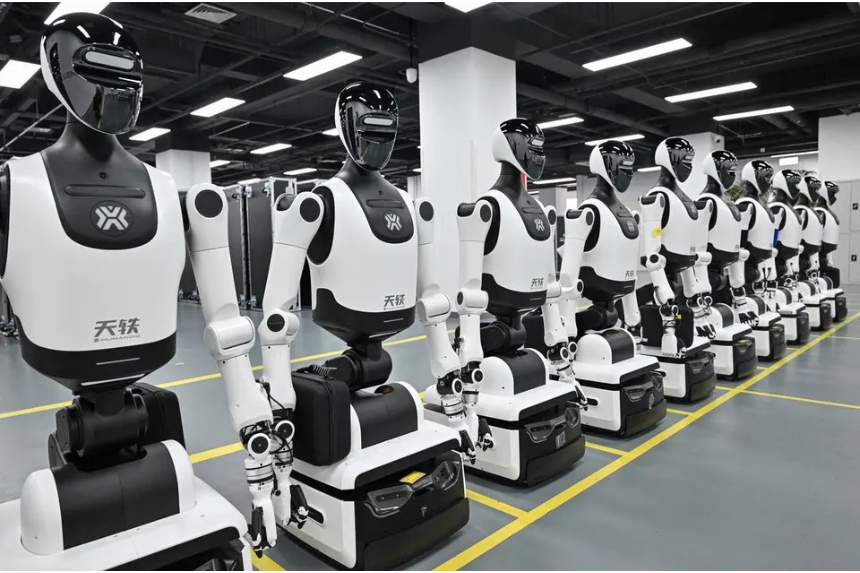
Remember our "dog days of summer" joke up top? Turns out it wasn't just a pun. On Tuesday, July 28, the FCC banned new imports of foreign-made humanoid and quadruped ("robot dog") robots, citing national security.
The details:
- The FCC will no longer grant equipment authorization for new imports of foreign-made humanoid and quadruped robots, plus networked power inverters. Named Chinese manufacturers: Unitree, Agibot, and UBTech — companies that together account for roughly 87% of global humanoid robot shipments.
- This is a forward-looking gate, not a recall. Robots already authorized and in the field can keep running and keep being sold.
- Justification: supply-chain dependency risk, plus cybersecurity concerns — the FCC specifically flagged that networked robots could be remotely commandeered or used for surveillance.
- Federal government agencies are exempt from the ban. There's also a conditional exemption pathway through the Department of War and DHS for specific products that can demonstrate they're not a risk.
- The clear winners: US and allied makers like Figure AI, Agility Robotics, Tesla, 1X, and Apptronik now have a protected domestic market.
Worth a raised eyebrow: the government's stated concern is that these robots could be "remotely commandeered" or used for surveillance — which is exactly the kind of thing you'd worry about most on a military base, a courthouse, or inside a federal facility. And yet those are precisely the buyers the exemption covers. If the security risk is real enough to lock private industry out entirely, it's fair to ask why the agencies handling the most sensitive environments get to keep buying the same hardware.
Why it matters for manufacturing:
Quadruped robots have quietly become a real tool for industrial inspection — patrolling refineries, checking gauges, doing thermal scans in hazardous areas nobody wants to walk into twice a shift. Unitree in particular built its industrial following on being dramatically cheaper than alternatives like Boston Dynamics' Spot. If your plant has been evaluating (or already piloting) that kind of low-cost quadruped fleet, this changes your shopping list going forward — not because your current units stop working, but because scaling up now means choosing from a shorter, pricier bench of domestic options.
Real-world scenario: Say you piloted two Unitree-based units for perimeter and gas-leak inspection because they ran a fraction of the cost of a comparable Boston Dynamics deployment. The pilot worked, and you budgeted to scale to twenty units next year. Those two units keep running fine — but your integrator just told you the expansion order can't clear FCC authorization anymore, and your remaining options (Figure, Agility, Boston Dynamics) cost meaningfully more per unit.
The bottom line: Existing Chinese-made robots on your floor aren't going anywhere, but if your robotics roadmap assumed you could keep buying the cheap option, it's time to rebudget around the pricier domestic names — or start the paperwork for an exemption.
From the Floor: This Week in the Community
While we were digging through this week's news, the 4.0 Solutions Discord was busy building its own. Here's what stood out from July 27 – August 2:
Two releases worth checking out:
bluegrass0346shipped MQTTProbe v1.0.3, an open-source MQTT tool built specifically for IIoT and Sparkplug B — worth a look if you're debugging broker traffic on the regular.Nickn5549dropped the beta for UNS Navigator, and the early reviews (shoutoutchristian23749) were genuinely positive. If you're building out a Unified Namespace and want a second set of eyes on your hierarchy, this one's worth a test drive.
The AI-agent debate nobody's finished having: A #general thread dug into what AI agents are actually doing to software engineering workflows — faster output, sure, but also a bigger QA and human-review burden than most teams expected going in. Sound familiar? We covered a version of this exact tension in our AI models piece above — turns out it applies to your dev pipeline, not just your shop floor.
The MES conversation that's more universal than it sounds: thiagopvr laid out the classic OT headache in #mes: when a machine logs a downtime "trigger," is that the same thing as the actual "cause"? Most teams map fault codes 1:1 to downtime reasons and call it done — but that conflates "what happened" with "why it happened," and it'll bite you the first time you try to run real root-cause analysis on the data. He also flagged something easy to overlook: if your OPC UA link or data pipeline goes down, your downtime logging goes down with it — so the health of the pipeline itself deserves as much monitoring as the tags flowing through it.
Friday Wins, and a growing crew: Friday's "Wins" thread included a member landing sign-off on a UNS proposal with a bottler client, plus the UNS Navigator hitting beta the same week. The server also picked up four new members Monday and a new full-stack engineer from Brazil (welcome, Feitosayrikes) with a background spanning industrial automation, IoT, and AI.
Still hanging out there — jump in if you've got an opinion:
- In
#mes: How do you actually handle the trigger-vs-cause gap? Fault codes mapped 1:1 to downtime reasons, or a separate layer? - In
#ai-and-ml: Anyone have a sanitized industrial dataset (pump, motor, etc.) they can share for testing? - In
#scada: Does Siemens WinCC OA ship with out-of-the-box alarm dashboards (top 10 offenders and the like), or are you building those from scratch?
Come weigh in on the Discord — we'll cover the best answers next week.
Not in the room yet? Come hang out in the Discord → — that's where the real work gets argued out.
Byte-Sized Brilliance
Here's a number that's hard to actually picture: Qwen 3.8-Max, the model Alibaba dropped this week, activates 95 billion parameters every time you ask it a single question. Your brain, for comparison, runs on about 86 billion neurons — total, for your entire life. One query to this thing briefly recruits more computational "cells" than the meat computer reading this sentence has ever owned.
And that's just the fraction it bothers to use. The full model has 2.4 trillion parameters sitting on the shelf — meaning roughly 96% of it stays idle for any given question, waiting to be the exact right specialist for whatever you ask next. It's less "one genius" and more an office tower with 2.4 trillion employees where only 95 billion show up to any given meeting.
Here's the irony worth sitting with: we're now routinely building AI systems with more raw parameters than there are neurons in a human skull — and pointing them at a $40 pressure sensor on Line 3, asking them whether a bearing sounds a little off. The gap between the scale of the model and the scale of the physical problem it's solving has never been wider.
The machine trying to understand your factory floor now has more moving parts than your factory floor does.
Let us know how we're doing! https://forms.gle/zSXrKTK9BNZ3BrpXA

Responses