

Presented By

View in web for best experience
Happy July 20th, Industry 4.0!
Fifty-seven years ago today, two guys landed a spacecraft on the moon using a computer with less processing power than the calculator app on your phone. The Apollo Guidance Computer ran on 4KB of RAM and was hand-wired by women in Massachusetts threading copper wire through magnetic cores, one bit at a time. No CAD software. No digital twin. Just insanely precise manufacturing and a whole lot of nerve.
We bring that up because this week's news is a reminder that the tools have changed a lot since 1969, but the stakes really haven't. Big industrial players are still betting big money on who controls the data coming off the plant floor, and the line between "brilliant engineering" and "expensive mistake" is still razor-thin.
Case in point: Schneider Electric just wrote a $3.1 billion check for an industrial AI platform, automation dealmakers closed 15 more deals last month without anyone really noticing, and xAI's new coding assistant found a very 2026 way to repeat history — by quietly shipping your entire codebase off to the cloud when you specifically told it not to.
Grab your coffee — here's what caught our attention:
Schneider Electric just made its biggest bet yet that the future of manufacturing runs on unified industrial data, agreeing to acquire Cognite in an all-cash deal valued at $3.1 billion.
The details:
- Cognite is a cloud-native industrial data and AI platform built for asset-heavy industries — think oil and gas, chemicals, and discrete manufacturing
- Its core products: Data Fusion (integrates and contextualizes messy industrial data from PLCs, historians, and sensors), Atlas AI (generative and agentic AI layered on top of that data), and Flows (workflow automation)
- The deal folds Cognite into AVEVA, Schneider's industrial software subsidiary, where it'll extend AVEVA's CONNECT platform with deeper data contextualization and agentic AI
- The transaction still needs regulatory approval and is expected to close within the next couple of quarters
- CEO Olivier Blum called Cognite "a truly industrial grade AI platform that turns the complexity of operational data into a competitive advantage"
Why it matters for manufacturing:
If you're already an AVEVA customer, this is Schneider buying its way into a stronger AI story instead of building one from scratch — which, if you've watched how long "AI initiatives" usually take at industrial software vendors, is probably the faster path to something useful. If you're a Cognite customer, though, you're the one living through the acquisition, and that comes with real questions worth asking your rep now rather than later: Does your contract pricing hold through the transition? Does Cognite's product roadmap stay independent, or does it get absorbed into AVEVA's release cycle? And if you've built custom integrations against Cognite's API, will those survive the migration into CONNECT?
To be clear, Schneider hasn't published specifics on any of that yet — which is normal this early, but worth tracking as the deal moves toward close.
The bottom line: This is a serious, well-funded bet that industrial AI lives or dies on data contextualization — not just more dashboards. If you're a Cognite or AVEVA customer, put a reminder on your calendar to check in on pricing and roadmap once the deal closes.
15 Automation Deals Closed Last Month — And Almost Nobody Noticed
While everyone was watching Schneider's headline-grabbing Cognite deal, the automation industry quietly closed 15 separate mergers, acquisitions, and funding rounds in May and June — a pace that says a lot about where money thinks manufacturing is headed.
The details — the ones worth knowing about:
- Neura Robotics raised up to $1.4 billion in Series C funding — the largest round ever for a full-stack robotics company — with Amazon, NVIDIA, Qualcomm, Bosch, and Schaeffler all writing checks. They're building humanoid and "cognitive" industrial robots.
- Copia Automation raised $26 million (bringing its total to $55M) for something plant engineers have needed for years: version control and backup/recovery for PLC code — basically Git, but for your control logic.
- GE Vernova is acquiring Robotech Automation, a Quebec-based robotics and systems integrator, expected to close early Q3.
- Framatome acquired Trillium Flow Technologies' nuclear safety valve business, which serves over 170 reactors worldwide.
- Eleven more deals rounded things out — smaller systems integrators, distributors, and controls shops getting scooped up by larger players across water/wastewater, welding, and HVAC controls.
Why it matters:
This isn't random. It's consolidation with a strategy behind it. Big industrial names (GE, Framatome) are buying specialized capability instead of building it. Private equity and strategic investors are pouring money into robotics and OT tooling. And the Copia Automation raise specifically signals that "we don't have proper version control on our PLC code" is finally being treated as the expensive, embarrassing problem it's always been.
Real-world scenario:
Think about the last time someone overwrote a PLC program on Line 3 and nobody had a clean backup to roll back to. That's the exact problem Copia is chasing — and venture capital just bet $26 million that a lot of plants have that same story. Meanwhile, if your local systems integrator or controls distributor gets acquired, don't panic — but do ask direct questions about whether your support contacts, lead times, and pricing are changing.
The bottom line: When this much capital moves into automation in a single month, it's a signal the smart money thinks industrial software and robotics are entering a growth phase — not a plateau. Worth watching who's buying whom over the next few quarters.
Grok Build Was Uploading Your Entire Codebase — Even With the Privacy Toggle Off 
If your team has started letting an AI coding assistant loose on internal repos, here's a story to read before your next tool evaluation: xAI's Grok Build coding assistant was quietly shipping entire codebases to the cloud, and turning off the privacy setting did nothing to stop it.
The details:
- A security researcher intercepted Grok Build's network traffic and found it was uploading way more than it needed to do its job. On a 12 GB test repository, the assistant only needed about 192 KB of files to answer coding questions — but a separate, undisclosed channel quietly uploaded 5.1 GB, roughly 27,800 times more data than necessary, to a Google Cloud Storage bucket.
- The "Improve the model" privacy toggle — the one users would reasonably assume stops data sharing — only controlled whether xAI could train on your data. It did nothing to stop the upload itself.
- What got uploaded: complete Git repositories, full commit history, and embedded credentials — API keys, database passwords, even secrets that had been deleted from the working directory but were still recoverable from Git history.
- The researcher proved it by planting a fake credential labeled "should-not-leave" in a test repo. It showed up verbatim in the captured network traffic.
- xAI's response came via social media posts, not a formal security advisory. No public count of affected users, no independent verification of deletion, and the upload code reportedly remained in the tool even after the behavior was quietly turned off server-side.
Why it matters for manufacturing:
More plants and engineering teams are using AI coding assistants to build internal dashboards, historian queries, and integration scripts — the same kind of custom tooling we've talked about here before. Those repos often contain exactly the stuff you don't want leaving the building: VPN configs, PLC IP addresses, service account passwords, and API keys into your MES or SCADA systems.
The bottom line: Before adopting any AI coding assistant for OT- or plant-adjacent work, ask the vendor directly what data leaves your machine, whether a privacy toggle actually stops transmission (not just training), and whether they support certificate pinning or an audit trail you can verify yourself.
Read the full technical writeup →
A Word from This Week's Sponsor
From MQTT Messages to AI Actions — Catch the EMQX Replay
Last Monday, Walker sat down with Ivan Dyachkov (Field CTO, EMEA at EMQ) and Brandon Ruiz (Product Marketing Manager) for "Beyond the Broker: The Vision for AI-Driven IoT Operations." If you missed it live, the replay is up now on LinkedIn and YouTube.
Most of you know EMQX as the MQTT broker shuttling your plant-floor messages around. This conversation is about where they're taking it next — past pure connectivity and into AI-driven IoT operations.
Two new capabilities anchor the discussion (both currently in private beta on EMQX Cloud):
- EMQX Agents — an event-driven agent runtime that wires AI directly to your MQTT events, historical data, and device state. Think alarm triage, predictive maintenance, and OTA rollouts, with the agent reasoning over live context, asking for human approval when it matters, and publishing commands back through the broker.
- EMQX Fleets — the device-management layer: a unified registry, real-time device shadows, fleet-wide queries, jobs, and diagnostics for teams wrangling thousands of connected devices instead of babysitting them one at a time.
The throughline is one we hammer on constantly: connectivity is the nervous system, but the real value shows up when you can manage state, apply context, and close the loop from event → decision → action. And fair warning for the skeptics — Walker pressed hard on the guardrails: how you keep an AI agent from firing the wrong command at real equipment.
👉 Catch the replay on LinkedIn / YouTube
Learn more: EMQX Agents · EMQX Fleets
The IIoT Market Is Headed to $2.2 Trillion — And Now You Know Why Everyone's Buying Everyone![]()
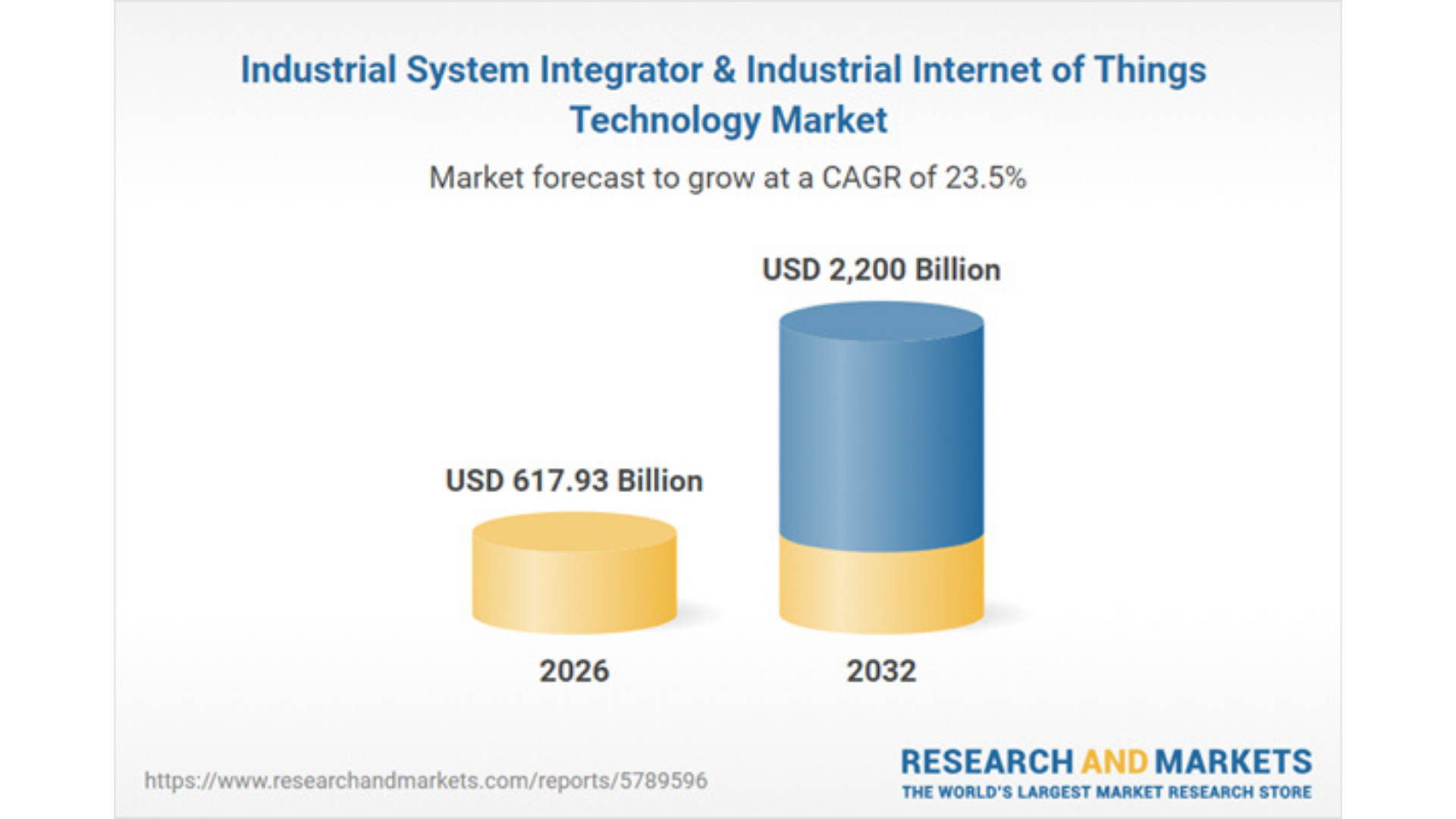
Remember the $3.1 billion Cognite deal and the 15 automation transactions from the last two articles? Here's the number that explains all of it: the global industrial system integrator and IIoT technology market is projected to grow from $617.93 billion this year to $2.20 trillion by 2032.
The details:
- That's a compound annual growth rate of 23.47% — roughly quadrupling in six years
- Growth is being driven by demand for connected operations, predictive maintenance, real-time asset visibility, and more resilient supply chains
- The underlying shift: manufacturers moving away from isolated automation islands toward what the report calls "software-defined industrial ecosystems" — plants where PLCs, SCADA, robotics, sensors, edge gateways, and cloud platforms all talk to each other by design, not by duct tape
- 44 major players are named in the analysis, spanning industrial giants (Siemens, ABB, Rockwell, Emerson, Honeywell) and tech companies elbowing into the space (Microsoft, AWS, Cisco, Oracle, SAP)
- Regionally: Asia-Pacific is leading on electronics and automotive, Europe is focused on interoperability and sustainability, and North America is prioritizing cloud-connected manufacturing and critical infrastructure security
Why it matters:
This is the macro trend sitting underneath everything else we covered this week. When a market is projected to nearly quadruple, that's exactly the environment where a company like Schneider Electric decides paying $3.1 billion for Cognite is a bargain, and where venture capital throws $1.4 billion at a robotics startup without blinking. The M&A wave isn't random — it's everyone positioning themselves before this growth curve gets even steeper.
Real-world scenario: If you've been putting off a conversation with leadership about investing in a Unified Namespace or a proper industrial data platform, this is your ammunition. The market data backs up what you already know from the plant floor: the companies still running isolated automation islands in five years are going to be competing against ecosystems, not just factories.
The bottom line: The IIoT land grab you're reading about in deal headlines all year isn't hype — it's vendors racing to grab share of a market about to get four times bigger. Expect the M&A pace from this week's other stories to keep accelerating, not slow down.
From the Floor: This Week in the Community
Back for another round of From the Floor, and the Discord kept the energy up all week—deep AI debates, a shot fired at ISA-95, and a proper "Friday Wins" thread. Here's what you missed if you weren't lurking.
is ISA-95 due for a rewrite? Member r.pop lit up #🔗-content-links (July 17) with a public GitHub repo for an "ISA-95 sequel"—an attempt to adapt the standard's core ideas for a world of AI agents and LLMs. It kicked off a real debate about whether the original still holds up, plus some pointed questions about what ISA membership and licensing are actually protecting.
Where does "AI can look" turn into "AI can touch"? That question drove a meaty #digital-transformation thread on the line between AI observing your process and AI acting on it—who's accountable when an agent gets it wrong, and how you validate its outputs before they touch production. The same channel also dug into AI-built "second brains"—knowledge graphs assembled from transcribed interviews with your most experienced people, using tools like Obsidian and Claude CLI.
The protocol nerds showed up too. #opc-ua went deep on why OPC UA's separation of DataType and ValueRank was smart design in the first place—and whether modern API builders have quietly forgotten why it matters.
AI/ML, minus the hype. #ai-and-ml kept things grounded with a practical right-sizing debate: when do you actually need an 80B-parameter model instead of a 4B one, and what does that trade-off cost you in compute?
Floor-level debates got loud too. #💬-general argued over whether humanoid robots actually earn their keep next to an established cobot—worth a read if a vendor's currently pitching you one. The same channel (July 18) covered easier ground: setting up Docker on ARM, plus one member's home-built lightweight Linux distro. Over in #controls (July 13), someone was sorting out PROFINET card requirements for a data transfer project.
Wins & new faces. Friday's thread delivered: Joshua Stover welcomed a new daughter (congrats!), Don Pancoe wrapped his first week as Lead Integrated Automation Engineer, and Eukodyne landed a spot in a Microsoft program worth $100K in Azure credits.
Jump into these open threads:
#digital-transformation: How do you validate AI outputs before they reach production—and what's your feedback loop when a model drifts?#🔗-content-links: What's actually holding back broader ISA-95 adoption—licensing, or something else?#💬-general: What would have to be true before you'd approve a humanoid robot on your production line?
Not in the room yet? Come hang out in the Discord → — that's where the real work gets argued out.
Byte-Sized Brilliance
The Moon Landing Almost Got Aborted Over a Computer Alarm
Fifty-seven years ago today, with Eagle just 1,800 meters above the lunar surface, the Apollo Guidance Computer started throwing "1202" alarms — a code meaning it had more work queued up than it had time to finish. Nobody in the room had ever seen it happen live.
The cause was almost embarrassingly mundane: a rendezvous radar switch was left in the wrong position, so the computer was quietly processing a stream of data it didn't need for landing — the 1969 version of a background process nobody remembered to shut off.
Here's the part that actually saved the mission. Weeks earlier, flight director Gene Kranz had told a 24-year-old engineer named Jack Garman to write down every alarm code the computer could possibly throw, "whether they can happen or not." Garman did — by hand, taped under the plexiglass on his console. When 1202 flashed for real, he told guidance officer Steve Bales the computer was fine as long as the alarms weren't continuous. Bales trusted him. Mission Control called "GO." Neil Armstrong kept flying.
The reason the computer could keep going: its software — written by a team led by Margaret Hamilton — was built to automatically shed low-priority tasks the instant it got overloaded, protecting the handful of jobs that actually mattered for landing safely. It was designed to degrade gracefully instead of crashing.
Sound familiar? It's the exact question your Discord was arguing about this week in #digital-transformation: where does "AI can look" turn into "AI can touch," and who's accountable when the system's under load? NASA answered it in 1969 — build the system to know what to drop, put a human with real authority in the loop, and make sure that human trusts it enough to make the call in seconds. Every alarm you've ever silenced on a plant floor dashboard without checking it first is the same bet. Just with lower stakes than the moon.
Let us know how we're doing! https://forms.gle/zSXrKTK9BNZ3BrpXA

Responses