

Presented By
View in web for best experience
The World Cup has North America in a happy chokehold, and the standings are pure chaos in the best way: Cape Verde — an island nation of barely half a million people, ranked 67th, here for the first time ever — held mighty Spain to a draw and muscled into the knockouts as the smallest country to ever get there, while Team USA topped its group with its best showing yet and the whole country quietly agreed that if the hosts actually win this thing, we get to officially rename it soccer and never speak of it again.
And to our readers across Europe riding out the record heatwave — stay cool and look after each other out there. We're thinking of you.
Here's the thread we keep pulling: for all the breathless talk of an "AI summer," the biggest story on Earth right now is people — a 40-year-old goalkeeper, a coach nobody rated, an underdog nobody picked — doing things no model would've forecast.
Manufacturing's been wrestling with the opposite instinct: automate the people out. So it was telling that this week Ford did the reverse — rehiring 350 of its retired "gray beard" engineers after its automated quality systems came up short. Turns out the folks who know why a weld cracks at 3 a.m. on a humid Tuesday aren't so easy to swap out for a model.
That tension runs through everything that caught our eye. Industrial AI promised to compress timelines, gut costs, and run the plant lights-out. 2026 is the year it met the shop floor — and the shop floor had notes.
We'll look at where AI is genuinely changing the game (hint: it's about intelligence, not bigger robots), where the economics are getting brutal enough to remake an 89-year-old carmaker, and the brand-new job that exists only because nobody trusts a swarm of AI agents to run unsupervised. The throughline: it was never "AI instead of people." It's AI plus the right people, in the right places, asking the right questions.
Here's what caught our attention:
VW's 100,000-Job Reckoning: What the EV Squeeze Looks Like When It Reaches the Plant Floor

Volkswagen — the world's No. 2 automaker — is reportedly planning the biggest restructuring in its 89-year history. And the numbers are the kind that ripple far beyond Wolfsburg.
The details:
According to a June 26 report in Manager Magazin (VW itself declined to confirm the "confidential documents"), CEO Oliver Blume is aiming to:
- Cut up to 100,000 jobs from a global workforce of roughly 660,000 — double the 50,000 cuts VW floated just months ago.
- Wind down production at four German plants (Hanover, Zwickau, Emden, and Audi's Neckarsulm) once current models age out.
- Slash planned investment by about 15%, to just over €130 billion ($148B) over five years.
- Spin the core VW brand and its parts operations into separate entities — easier to list on the market later.
Why now? A brutal three-way vise: the costly EV transition, Chinese competitors eating share, and U.S. tariffs that the CFO pegs at roughly €4 billion a year. Q1 net profit already fell 28%. Translation: the savings plans on the table weren't cutting it.
Why it matters
Here's the thing — this isn't just a VW story, it's a supplier story. When an OEM this size cuts capital spending 15% and closes plants, the shockwave runs straight through the Tier 1 and Tier 2 base: fewer new lines, delayed automation projects, renegotiated contracts. If your shop has heavy exposure to one big customer, their austerity becomes your forecast.
And note the irony for our theme: automation is usually sold as the answer to labor cost. But VW's squeeze is so deep it's cutting the automation budget too. "Cut your way to competitive" is the strategy of the moment — the hard part is knowing what's actually load-bearing.
The bottom line: The EV-era margin squeeze is real, and even giants are reaching for the scalpel — but VW's own math suggests the hard call isn't whether to cut, it's figuring out what was holding the building up.
Ford Brings Back the "Gray Beards": When AI Quality Systems Hit Their Limits
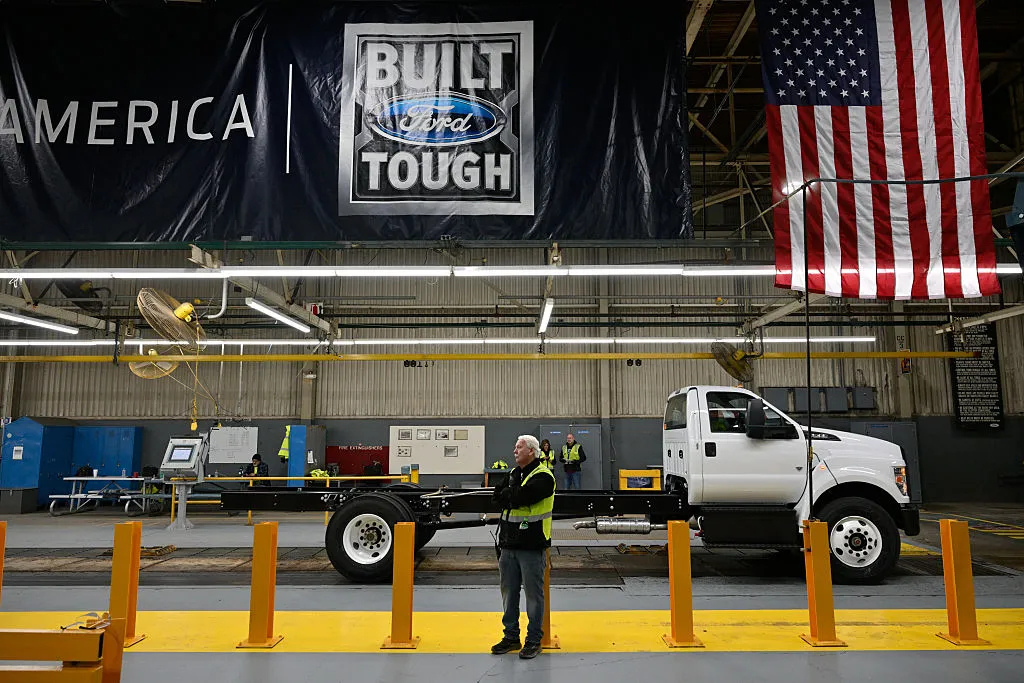
For two years the industrial pitch has been automate the inspection, ingest the specs, let the model catch the defects. This week Ford admitted that, for quality, it didn't work — and went out and rehired the humans.
The details:
Ford executives said the company brought back 350 veteran engineers — internally nicknamed the "gray beards" — after leaning harder and harder on automated quality systems produced disappointing results. Some are former employees; others were pulled back from suppliers.
COO Kumar Galhotra said these specialists now hunt for failure points before a part ever reaches the plant floor. And VP of vehicle hardware engineering Charles Poon was refreshingly blunt about the miscalculation: the team had assumed that simply pointing AI at their design requirements would automatically yield a high-quality product. It didn't.
Two things worth underlining, because they're easy to miss:
- This isn't an anti-AI move. The gray beards aren't replacing the tools — they're being used to train younger staff and reprogram the AI itself.
- It's paying off. Ford expects roughly $1 billion in cost reductions this year and just took the top spot among mainstream brands in the JD Power Initial Quality Survey released this week.
Why it matters for manufacturing:
Here's the lesson, and it's a big one: an AI model is only as good as the judgment baked into it. Quality engineering isn't just pattern-matching against a spec sheet — it's tacit knowledge. It's knowing that a tolerance is technically in-spec but will fail in the field, or that a supplier's process drifts every August when the humidity climbs. That knowledge lives in people who've watched parts fail for 30 years, and it was never written down for the model to ingest.
Translation: AI didn't fail because the technology is bad. It failed because someone fed it the documented requirements and assumed that was the whole picture. The undocumented 20% — the engineering intuition — is exactly where quality lives or dies.
What to do this week:
- Find your gray beards before they retire. Map who holds the undocumented quality knowledge — and start capturing it now, not at their exit interview.
- Treat AI quality tools as apprentices, not replacements. Pair every automated inspection rollout with a veteran who reviews edge cases and feeds corrections back in.
- Audit what your model was actually trained on. If it only knows the written spec, it doesn't know what your best engineer knows.
- Build the feedback loop. Field failures should flow back into the model and the humans tuning it.
The bottom line: Ford's billion-dollar lesson is the whole issue in one move — the win wasn't AI or people, it was AI taught by the right people. The model scales the knowledge; it can't originate it.
Physical AI: Why the Next Edge Is Intelligence, Not a Bigger Robot

Here's a counterintuitive idea gaining steam heading into the back half of 2026: the manufacturers who pull ahead in the next two to three years won't be the ones with the fattest automation budgets. They'll be the ones with the smartest intelligence directing the machines they already own.
The details:
A wave of analysis converging around Automate 2026 (the big automation show that ran June 22–25 in Chicago) keeps landing on the same point — the bottleneck has moved. For years it was the hardware: not enough robots, not enough cells. Now the hardware is plentiful and the constraint is the software brain telling it what to do in a messy, unpredictable physical world.
The buzzword for that brain is physical AI. Let's define it plainly:
- Physical AI = systems that can interpret and react to the real physical environment — variable parts, lighting, wear, vibration — instead of only performing inside a clean digital simulation.
- Embodied AI = that intelligence wrapped inside a robot or machine that physically acts on the world.
- The sim-to-real gap = the painful distance between "it worked perfectly in the simulation" and "it works on an actual line at 2 p.m. with a slightly warped fixture." Closing that gap is, per the people building these systems, the core engineering challenge right now.
The argument for why this matters commercially: Palladyne AI's commercial chief frames embodied robotics as the answer to manufacturing's "great margin squeeze" — not as a cost-cutting play, but as throughput resilience. The idea is robots flexible enough to handle high-mix, low-volume work with fast changeovers and fewer line-stopping exceptions, without throwing more engineers at every new product variant. MarketScale
Why it matters for manufacturing:
Most plants don't have a robot shortage — they have a flexibility shortage. The cell that runs flawlessly on one part for six months and then needs three weeks of re-engineering for the next variant is the real cost center. Physical AI's promise is closing that re-engineering tax: machines that adapt to the new part instead of demanding a new program.
Translation: the value isn't "buy more automation." It's "make the automation you have smart enough to handle reality."
What to do this week:
- Audit your changeover tax. How many engineering hours per new variant? That number is your physical-AI business case.
- Pilot on flexibility, not replacement. Target the high-mix line that breaks every time the schedule changes.
- Interrogate the sim-to-real gap hard. Ask any vendor to prove it on your parts, in your lighting, with your fixtures — not in a demo cell.
- Keep your humans in the loop (sound familiar?). Adaptive systems still need engineers to set boundaries and validate edge cases.
The bottom line: The next competitive edge in manufacturing isn't measured in robot count or capex — it's measured in how well your machines handle the chaos of the real world. Intelligence, not iron.
A Word from This Week's Sponsor
Your AI Writes Code Fast. Then It Breaks. Here's the Discipline That Fixes It.
This whole issue has been about the same lesson: AI without the right humans in the loop falls apart. Nowhere is that truer than in software. Teams adopting agentic AI keep hitting the same wall — once a project gets big enough, regression rates climb past 50%. Every new sprint breaks something that worked yesterday. The code gets written fast, then collapses under its own weight.
The problem isn't the AI. It's the missing DevOps discipline — structured documentation as live context, agent personas, version control, peer review — that keeps AI-built software working sprint after sprint instead of just once.
That's the entire premise of Agentic DevOps for Industry 4.0, the next live workshop from Walker Reynolds and IIoT University.
What you'll actually do: Over two hands-on days, you'll stand up a complete agentic pipeline — Claude Desktop Project Agent, Claude Code Developer, and Cursor Peer Review Agent — and use it to ship a real, working Industry 4.0 tool to a private GitHub repo by the end of Day 2. Not a toy demo. A tool your work actually needs — and the cohort votes on what gets built, so registering early means you get a say.
Who it's for: Engineers, system integrators, and OT/IT pros who know Industry 4.0 (UNS, MQTT, edge/cloud) but don't have a software-development background. If you can describe the tool you wish you had, you're ready to build it.
The details:
- 📅 July 21–22, 2026 · 9:00 AM–1:00 PM CDT each day · Live on Zoom
- 💰 Early-bird: $1,099 (list price $1,499) — or free for Mastermind members
- 🎥 Every session recorded — registrants get lifetime access plus the GitHub repo and reference materials
- ✅ Refundable up to 24 hours after purchase, before the workshop begins
Why this fits the week: Ford put veterans back in the loop to keep its AI honest. This workshop teaches you the software-side version of the same move — the human discipline that turns fast-but-fragile AI code into systems that hold up at scale.
Lock in the early-bird rate and reserve your seat →
The "AI Orchestrator": The New Job That Exists Because Nobody Trusts Agents to Run Alone
There's a hot new title showing up on job postings, and it tells you everything about where agentic AI actually is in 2026: companies are now hiring AI orchestrators — the humans whose entire job is making sure a swarm of AI agents plays nicely together.
The details:
First, a quick definition, because the jargon moves fast:
- An AI agent is software that doesn't just answer questions — it takes actions. It pulls data, makes a decision, and hands the result to the next step (or the next agent).
- Agentic AI is what you get when you chain a bunch of those together to run a whole workflow with minimal human input.
- An AI orchestrator is the human in the loop who supervises that chain.
Armando Franco of TEKsystems Global Services describes the role plainly: orchestrators take AI processes that have been handed off to them and make sure the agents, once they're live in production, are working collaboratively and staying within their boundaries. If an agent grabs a pile of data and decides to do something with it, the orchestrator reviews that decision before it's passed to the next agent — adding a layer of security, confirming the governance is in place, and verifying the agents are behaving correctly.
Translation: it's a quality-control checkpoint for machine decisions. The agents do the work; a person makes sure they didn't do something dumb, unsafe, or out of bounds before it cascades downstream.
Why it matters for manufacturing:
In IT, a misbehaving agent corrupts a spreadsheet. On the plant floor, the stakes are physical. Picture a maintenance agent that reads vibration data and autonomously schedules a line-down repair, or a procurement agent that reorders stock, or a scheduling agent that reshuffles production. String those together and a single bad handoff — one agent acting on bad data — can ripple into real downtime, wasted inventory, or a safety event.
That's exactly why this role is emerging. OT has never allowed unsupervised autonomy over physical processes, and it isn't about to start. The orchestrator is the governance layer that lets you capture agentic efficiency without handing the keys to the kingdom to software that occasionally hallucinates.
What to do this week:
- Before you deploy agents, decide who orchestrates them. Autonomy without a checkpoint is a liability, not a feature.
- Define hard boundaries for every agent — what it can read, decide, and trigger on its own vs. what requires human sign-off.
- Put the checkpoint where the stakes are physical. Any agent action that moves a machine, spends money, or stops a line gets a human gate.
- Grow the role from inside. Your best orchestrators already understand your processes — the OT engineers who know what "out of bounds" actually means on your floor.
The bottom line: The arrival of the "AI orchestrator" job is the quiet admission underneath all the agentic hype — the more autonomous the system, the more it needs a human who knows when to say no.
Learning Lens
The Viral Claude Skill That Teaches AI to Write Less Code
This whole issue is about AI plus the right judgment — so it's fitting that the most talked-about thing in agentic coding right now is a free skill that bottles up exactly that. It's called ponytail, and in a matter of weeks it's rocketed past 55,000 GitHub stars.
The premise is perfect: it makes your AI coding agent think like "the laziest senior dev in the room" — the one who looks at your fifty lines, says nothing, and replaces them with one. Instead of installing a library and scaffolding a custom component for a date picker, the agent reaches for a native <input type="date">. Question whether the feature needs to exist at all (YAGNI — "You Aren't Gonna Need It"), reuse what's already in the codebase, prefer the standard library, one line before fifty.
The numbers — and the honesty behind them: The maintainer's benchmark (real Claude Code sessions editing a live FastAPI + React repo) reports roughly 54% less code on average — up to 94% where an agent badly over-builds — plus ~20% cheaper and ~27% faster. But here's what actually earns trust: when a reviewer called the original test unfair, the author rebuilt it from scratch, found and publicly disclosed a bug that had inflated an earlier result, and even shipped a benchmark where the skill flopped on a small local model. That's the opposite of vendor math.
The honest caveat, straight from a security reviewer who tested it: it's an instruction layer, not magic. It raises the odds your agent keeps things simple — it doesn't replace a real code review.
Why it matters for you: In the build-your-own-tools era, more OT and IT folks are using agents to ship dashboards, connectors, and quick scripts. The catch: AI loves to over-build, and every extra line is one more thing to maintain and break in production. A skill that enforces "delete before you add" is cheap regression insurance for the tools you'll actually run on the floor.
It's free and works with Claude Code, Codex, GitHub Copilot CLI, Cursor, and more.
Byte-Sized Brilliance
Around 1922, Henry Ford hit a problem his own engineers couldn't crack: a massive generator at his plant had failed, and nobody could find the fault. So Ford called in Charles Steinmetz — GE's cigar-chomping electrical genius, and about as close to the original "gray beard" as it gets.
Steinmetz asked for a notebook, a pencil, and a cot. He listened to the machine and scribbled equations for two days straight, then climbed a ladder, drew a single chalk mark on the casing, and told Ford's skeptical engineers to open it right there and replace exactly 16 windings. They did. The generator purred back to life.
Then the bill landed: $10,000 — roughly $180,000 in today's money. A stunned Ford demanded an itemized invoice. Steinmetz sent back two lines: making the chalk mark, $1; knowing where to make it, $9,999.
(The story has almost certainly been polished over the decades — versions of it predate Steinmetz entirely — but it's survived a century because every engineer who hears it knows it's true.)
And here's the bookend: this week, Ford reached for the exact same lesson and wrote a much bigger check — rehiring 350 veterans whose entire value is knowing where to make the mark. A hundred years apart, the invoice reads the same. The chalk is cheap. Knowing where it goes is the whole job — and it's the one line item AI still can't write for itself.
Let us know how we're doing! https://forms.gle/zSXrKTK9BNZ3BrpXA

Responses