

Presented By

View in web for best experience
Happy July 27th, Industry 4.0!
It's the last week of July, which means it's disgustingly hot outside, your AC unit is working overtime, and somewhere in a data center, a very expensive cluster of chips is sweating just as hard trying to keep itself from melting. Summer: it's rough on humans and silicon alike.
Turns out the industrial world is feeling just as toasty this week, minus the sunscreen. Big checks are getting written, new hardware is shipping, and because nothing stays simple for long... some folks in Tehran decided this was a great week to go poking around in water treatment plants.
We've got a multi-billion-dollar chip bet, a Korean shipbuilder and a German industrial giant deciding to be best friends, a shiny new box for getting your PLC data to actually go somewhere useful, and a cybersecurity story that's less "if" and more "when." No idle season here.
Grab your coffee... or [insert preferred energy drink here], here's what caught our attention:

Siemens just signed a nine-figure contract to become HD Hyundai's core technology partner for modernizing American shipyards. The pitch is a "repeatable blueprint" for digital shipbuilding... which sounds great, right up until you remember that digital thread has never actually been repeatable at this kind of scale.
The details:
- Announced July 23, the deal makes Siemens the key tech partner for HD Hyundai's next-generation shipbuilding strategy in the US
- The stated goal: one "repeatable blueprint" that works whether a yard is still on paper drawings or already has some digital tooling in place
- The tech underneath is the full Siemens Xcelerator stack, wired together as one connected system:
- Designcenter — ship design and engineering
- Teamcenter — PLM (product lifecycle management), tracking every design change and configuration across a ship's life
- Opcenter — MES (manufacturing execution system), the software running actual shop-floor production
- Plant Simulation — models and optimizes production before anything gets built
- Simcenter — simulation and systems engineering
- Intelligence Center X — a new AI layer pulling insights out of everything above
- They're also opening a U.S.-Korea Shipbuilding Technology Cooperation Center in D.C. to coordinate the rollout
- Notably absent from the announcement: any concrete implementation timeline
Why it matters for manufacturing:
"Digital thread" means one connected flow of data from design through production to lifecycle tracking, instead of the usual mess of disconnected CAD, MES, and historian systems. That's a real and worthwhile problem to solve. The catch is that digital thread only works when everyone touching the product is wired into the same system — and shipbuilding is one of the most subcontractor-heavy industries there is.
Here's the thing about "repeatable": in practice, digital thread rollouts are notoriously bespoke. Every yard's tagging structure, legacy tooling, and undocumented tribal knowledge is different, so "repeatable" tends to quietly become "we'll custom-integrate each site as we go." This is the same pattern that's dragged down PLM megaprojects in defense and aerospace before... ballooning timelines and endless re-scoping, not because the software doesn't work, but because stretching one thread across dozens of contractors and legacy systems is a data-governance problem, not just a technology one.
The bottom line: Digital thread demos always look flawless in a single-vendor sandbox. The real test is whether this survives contact with HD Hyundai's actual subcontractor web. Watch for whether Siemens publishes specifics on bridging legacy and third-party systems, not just replacing them, because that's the detail that separates a real rollout from a press release.
Belden's New Edge Gateway Fixes the Protocol Mismatch Every Plant Quietly Lives With
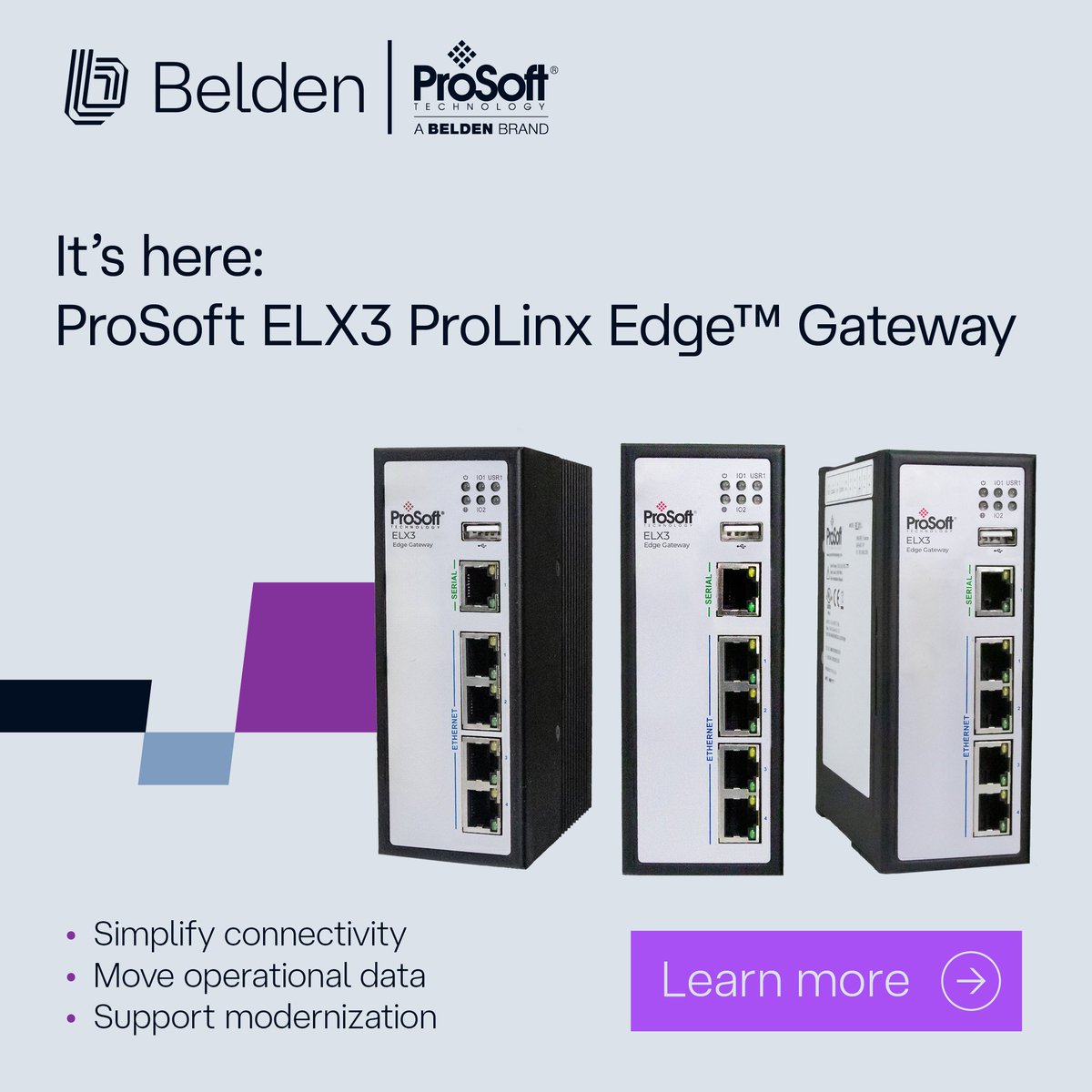
Belden's ProSoft Technology brand just launched a gateway that translates between two of the most common industrial protocols and runs actual software at the edge, tackling a problem most plants currently solve with duct-tape middleware or a PC nobody wants to maintain.
The details:
- Launched July 9: the ELX3 ProLinx Edge Gateway
- Converts between EtherNet/IP (common in Rockwell/Allen-Bradley environments) and Modbus TCP/IP (an older but still widely used protocol that tons of legacy instruments and meters only speak)
- Built to withstand harsh industrial conditions — though Belden's announcement doesn't spell out specific IP ratings or temperature range, so that's worth confirming directly before you spec it into a project
- Supports Docker — meaning it can run small, self-contained software packages directly on the gateway itself, not just pass data through
- Aimed at oil and gas, power distribution, and logistics operations, industries with a lot of distributed, hard-to-reach equipment
Why it matters for manufacturing:
Protocol translation is one of those unglamorous problems that eats way more budget than it should. Most plants are running a patchwork of hardware eras, newer PLCs speaking EtherNet/IP right next to a decade-old flow meter that only understands Modbus. Bridging that gap usually means custom integration work or a dedicated PC babysitting a translation script. A purpose-built gateway that does the translation and runs your own logic on top of it is a meaningfully smaller lift.
The Docker support is the more interesting detail here. It turns this from a dumb protocol translator into something that can pre-process data right at the source, filtering noise, aggregating readings, before anything gets sent up to a historian or the cloud. Less data to ship, less latency, and it still works if your connection to the cloud drops.
Real-world scenario: Line 2's flow meters only speak Modbus, but the new PLC upgrade runs EtherNet/IP. Instead of ripping out perfectly calibrated equipment or building custom middleware from scratch, a gateway like this sits in between, translates traffic both directions, and can run a small container that catches anomalies locally, so you're not waiting on a round trip to the cloud to know something's wrong.
The bottom line: Protocol translation and edge preprocessing sound boring right up until you're the one manually rewiring old instrumentation into a new network. This is exactly the kind of unglamorous hardware that quietly keeps digital transformation projects from stalling out at "we can't even get the data off the floor."
Iranian Hackers Just Widened Their PLC Target List — Water and Energy Utilities Are in the Crosshairs

CISA and the FBI issued a joint warning that Iranian-affiliated hackers have expanded their industrial control system campaign well past where it started. They began with Rockwell Automation devices — now they're going after Schneider and Siemens PLCs too, with water and energy infrastructure specifically named as targets.
The details:
- The advisory, published July 23, describes an active, ongoing campaign — not a hypothetical
- Originally focused on Rockwell/Allen-Bradley controllers, the campaign has expanded to include:
- Schneider Electric BMX P34 / Modicon M340 PLCs
- Siemens S7-1200 series PLCs
- Attack method: exploiting an authentication bypass flaw (CVE-2021-22681) in Studio 5000 Logix Designer — Rockwell's PLC programming software — that lets attackers recover the cryptographic keys meant to protect PLC programs from tampering
- Once in, attackers used Dropbear SSH, a lightweight remote-access tool, to maintain persistent access
- CISA's recommended fixes: enable multifactor authentication and change default passwords, patch affected software, segment OT networks from the internet with firewalls/VPNs, and check your PLC project files for unauthorized modifications
Why it matters for manufacturing:
You don't have to run a water utility for this to be your problem. Rockwell ControlLogix/CompactLogix, Siemens S7, and Schneider Modicon are some of the most common PLC families in manufacturing, period — the vulnerability isn't unique to water and energy, that's just where this campaign has been observed so far. An "expanding target list" in a public advisory is usually a sign of a campaign that's still testing what works before it goes broader. And PLC patching lags IT patch cycles for a reason — you can't just reboot a production line the way you patch a laptop, which is exactly why a four-year-old CVE like this one is still worth worrying about.
Action items:
- Confirm you're not running default credentials on any PLC or engineering workstation
- Patch Studio 5000 Logix Designer if you're on an affected version
- Verify your OT network actually has no direct path to the internet — not "probably," verify it
- Compare your current PLC project files against a known-good backup to check for unauthorized changes
The bottom line: CISA doesn't expand a target list in a public advisory unless they're already seeing it happen. If your plant runs Rockwell, Siemens, or Schneider PLCs — and let's be honest, most of us do — this is a good week to check default passwords and network segmentation, not a good week to assume it's someone else's problem.
Read the full advisory coverage →
A Word from This Week's Sponsor
EMQX Is Done Being "Just the Broker"
If the last time you looked at EMQX was strictly for MQTT (the messaging protocol most plant-floor devices use to talk to each other) and nothing else, you're overdue for a second look. Two releases worth your attention this week:
EMQX Fleets — Cloud device management for teams tired of babysitting devices one at a time. Manage millions of them from a single registry, with real-time digital twins running over MQTT 5.0. Query, configure, and push jobs across your entire fleet, with delivery tracking built in — no custom APIs to build and maintain yourself.
EMQX Agents — An event-driven AI runtime that reads your live MQTT telemetry and can actually act on it, not just flag it. Built-in sandboxing, topic allowlists, and human-approval gates mean the agent isn't making unsupervised calls on your plant floor — it's proposing them, with guardrails you control.
That kind of platform doesn't get built overnight. It's why more than 1,500 customers and 500+ million connected devices across manufacturing, automotive, and energy are already trusting EMQX to run it.
👉 Get in touch with the EMQX team or start a free trial
Learn more: EMQX Agents · EMQX Fleets
Anthropic Says Opus 5 Matches Its Flagship Model at Half the Price — Independent Testers Have Some Notes![]()

Anthropic released Claude Opus 5 on July 24, pitching it as delivering the same "frontier intelligence" as its pricier flagship model, Claude Fable 5, for half the cost. Independent testers mostly agree — with a few caveats worth knowing before you build anything on top of it.
What Anthropic claims:
- Pricing holds steady at the previous Opus model's rates: $5 per million input tokens, $25 per million output tokens (tokens are roughly the chunks of text a model reads and writes — think words and word-fragments)
- A new "Fast" mode runs about 2.5x quicker, at double the price
- On Anthropic's own numbers, Opus 5 more than doubles its predecessor's score on a coding benchmark called Frontier-Bench, triples rivals' scores on a novel-problem-solving test (ARC-AGI 3), and beats competitors 1.5x on a Zapier business-automation benchmark
- One notable gap Anthropic itself disclosed: Opus 5 trails a competing model called Mythos 5 specifically on offensive cybersecurity tasks — worth flagging given how much this newsletter covers OT/ICS security
What independent testers found:
- Epoch AI's capability index scored Opus 5 at 159 versus 161 for Fable 5 — a gap testers generally agree is marginal
- Artificial Analysis's independent Intelligence Index put Opus 5 at 61, statistically tied with Fable 5's 60 and ahead of OpenAI's GPT-5.6 Sol at 59 — while running about 26% cheaper per task than Fable 5
- Code review platform CodeRabbit found Opus 5 caught more genuinely useful issues than its predecessor (39.3% vs. 35.2% precision), but also generated four times as many low-value "nitpick" comments — meaning more manual triage for whoever's reviewing its output
- The real catch: Opus 5's hallucination rate — how often it states something false with full confidence — rose 14 percentage points to 50% on a knowledge-accuracy benchmark, even though its raw factual knowledge score improved slightly
- One evaluator described it as having a "neurotic streak," and it reportedly refuses certain tasks outright, like resolving code merge conflicts
Why it matters for manufacturing:
More plants and engineering teams are leaning on AI coding assistants like this to build internal dashboards, automate reporting, or debug custom scripts — something we've flagged the risks of doing carelessly before. Which model you pick for that work should come down to real, measured differences in cost and accuracy, not launch-day marketing copy. This is exactly the kind of independent data that should inform that call.
The bottom line: Anthropic's "frontier performance at half the price" claim holds up reasonably well against independent testing, at least on coding and agentic tasks. But "reasonably well" isn't "unconditionally" — and a rising hallucination rate is the kind of detail that's easy to miss in a launch announcement and expensive to discover after you've already trusted the output.
Read Anthropic's announcement →
Independent testers' verdict (Yellow) →
Artificial Analysis benchmark breakdown →
From the Floor: This Week in the Community
Back for another round of From the Floor. This week the Discord conversation centered on a debate over exactly when AI-generated content crosses from "genuinely useful" into "slop," alongside some real product-building wins. Here's what you missed if you weren't lurking.
People are building real things with this stuff. #digital-transformation got a genuine showcase on Friday (7/24) when Buff_engineer walked through an entire portfolio built with Claude Max — an employee scheduler, a CRM, a workout tracker, even a personal finance app. Over in #💬-general, Rudyv0700's Friday Win was launching IgnitionAISkills.com, an AI tool built specifically for Ignition developers, complete with actual first sales. And if you want a number for your next budget conversation: #product-recommendations (7/21) had a member reporting a 20-30x ROI on their enterprise Claude subscription.
Not everyone's sold, though. #mentorship-program — our private channel for members of the 4.0 Solutions mentorship program — spent real time this week (7/23, 7/24, 7/26) on what one member called the "AI slop deluge": low-effort AI-generated content and "snake oil" coding sessions crowding out anything genuinely useful. The same thread flagged a specific tell — AI-written video scripts that read fine on paper but lack the natural cadence and imperfection of an actual human talking. This is exactly the kind of practical, no-BS discussion that happens in there weekly; if you want in on it, this is your sign to ask us about joining the mentorship program.
Quick hits: #unified-namespace worked through UNS governance for a member building one out for a defense contractor. #ai-and-ml debated when a Raspberry Pi is genuinely enough for local AI versus when you're kidding yourself about the tradeoffs. And #💬-general got philosophical over which long-held industry assumptions — vendor lock-in chief among them — are already obsolete in the AI era.
Wins & new faces. Sunday's Friday Wins thread covered health milestones, business launches, and technical wins across the board. The community also welcomed a strong batch of new members this week in #🤳-introduce-yourself-here: a business architect focused on modernizing MES, a founder of multiple manufacturing tech startups, and new faces bringing IIoT, Sparkplug B, and life sciences manufacturing backgrounds to the table.
Jump into these open threads:
#mentorship-program: Where's the actual line between AI-assisted content and "slop" — and how do you tell before you hit publish? (members only)#product-recommendations: What's really driving a 20-30x ROI claim on an AI subscription, and how would you verify that number yourself?#ai-and-ml: When is a Raspberry Pi genuinely enough for local AI, and when are you just kidding yourself about the tradeoffs?
Not in the room yet? Come hang out in the Discord → — that's where the real work gets argued out.
Byte-Sized Brilliance
Today marks 73 years since the guns went quiet on the Korean Peninsula — the armistice was signed at Panmunjom on July 27, 1953. It's worth remembering that's all it was: a ceasefire, never upgraded to an actual peace treaty. North and South Korea are still, on paper, at war.
One of the best stories from that war happened a year earlier and has nothing to do with diplomacy. In March 1952, the battleship USS Wisconsin was pounding North Korean supply lines near Songjin when a shore battery landed a single ~150mm shell on her port side. The hit shattered some deck planking, wrecked a gun-mount shield, and wounded three sailors — barely a scratch on a battleship that size.
Wisconsin's response was, let's say, disproportionate. Her crew found the shore battery and answered with a full broadside from all nine of her 16-inch guns — nine shells, 2,700 pounds each, roughly the weight of a small car, landing at once. Her escort destroyer, USS Buck, reportedly signaled over: "Temper, temper." North Korea never took another shot at Wisconsin for the rest of the war.
Let us know how we're doing! https://forms.gle/zSXrKTK9BNZ3BrpXA

Responses